Design
Launch and verification
The action runs briefly under Herdr; the bridge stays in the agent pane for the lifetime of the session. The server and client run in separate nono sandboxes, while verification and the pane mapping stay outside both.
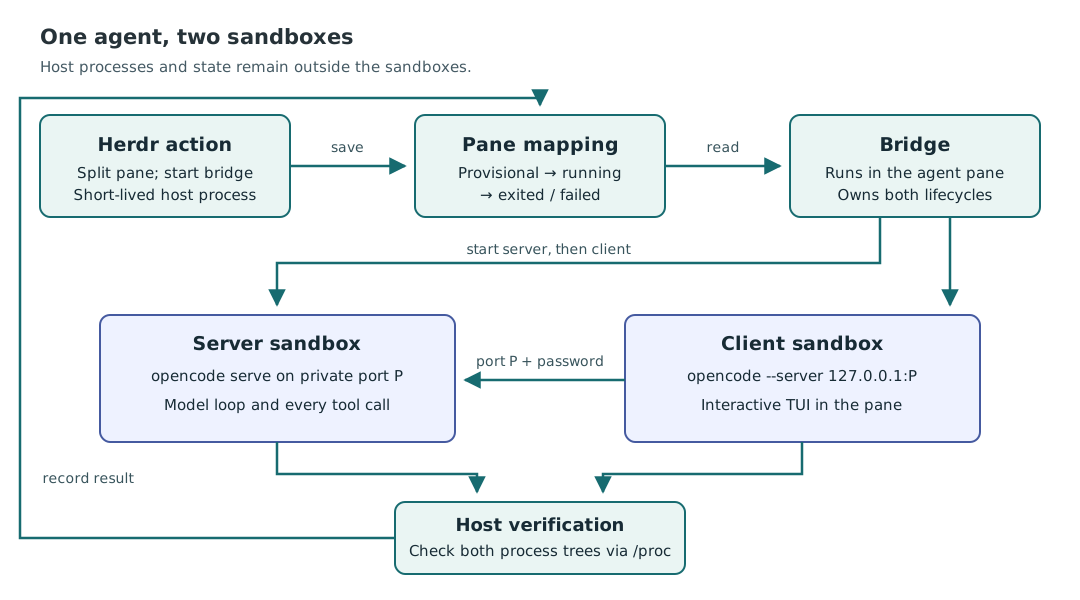
The client can reach only its private server port; the server runs tools and uses nono's proxy for allowed provider hosts. See Security for the network and trust boundaries.
Two plugin processes
Herdr runs plugin actions as short-lived processes without a terminal, so anything interactive lives in a pane:
- The action (
herdr-nono action, started by Herdr throughbin/run.sh) resolves the context, splits the pane, stores a mapping and prints the result line. - The bridge (
herdr-nono bridge) is typed into the new pane. It starts both sandboxes, verifies them, and records the exit.
Both are subcommands of the one binary the plugin installs as bin/herdr-nono;
so are the overlay (herdr-nono pane) and the worktree.removed hook
(herdr-nono events).
Launch sequence
- Pick the workspace root and refuse home and
/. - Split a pane, store a
provisionalmapping, type the bridge command. - The bridge stops leftover servers of this mapping, picks a free port
Pand a password. - Server, detached from the pane, output to a log file:
nono run --profile <server> --allow <root> --listen-port P -- opencode serve --hostname 127.0.0.1 --port P. Wait until it answers. - Client in the pane:
nono run --profile <client> --allow <root> --open-port P -- opencode --server http://127.0.0.1:P. Both getOPENCODE_PASSWORD;HERDR_*and socket variables are removed. - Verify both process trees until they pass (up to twenty seconds); stop on failure.
- When the client exits, stop the server and record the exit code.
Choices
- A private server per pane. OpenCode's server runs the tools, so it must run in a sandbox the plugin started; the host service never does.
- Two sandboxes, not one.
opencode --standalonein one sandbox needs open loopback, which makes the host service reachable. Every nono mode that closes loopback breaks standalone mode, but proxy mode accepts an explicit--listen-portand blocked mode an explicit--open-port. So the server uses proxy mode, the client blocked mode, and the plugin owns the port and password between them. The cost is nono's rate limit in proxy mode. --standaloneis stripped. The pack profilenolabs-ai/opencodesetscommand_args: ["--standalone"], which nono appends to every command run under a profile that extends it, and a profile cannot clear it. OpenCode 2.0.22 rejects the flag onopencode serveand next to--server, and a shell rejects it too. So every sandboxed command runs through a smallsh -cwrapper that drops it andexecs the real command.- Profiles on top of the pack.
nolabs-ai/opencodedescribes what OpenCode needs; the plugin adds only what a Herdr pane needs and passes its profiles by path, installing nothing. - Verification from outside.
/procshows what processes actually carry, and checking the tree catches a client talking to a server outside the sandbox. It fails closed by default. --allow <root>, never--allow-cwd. The grant must not followcd.- Ownership by process record. The bridge and shells record pid and start time, so actions never touch a mapping whose agent still runs.
- No persistent sandbox. A nono sandbox is a process; there is nothing to
create ahead of time or delete. This is why herdr-sbx-plugin's
fetch-changes,open-portandreplace-sandboxhave no counterpart.
State
One JSON file per pane under panes/ in the plugin's state directory, written
atomically under a lock. It ties the pane to a session name, the granted
directory, the last launch (profiles, port, supervisor pids, exit code), the
last verification and a lifecycle state: provisional, starting,
running, exited or failed.