Security
Why OpenCode needs two sandboxes
OpenCode 2.x is a client and a server. The client is only the TUI; the
server runs the model loop and every tool call (bash, file edits, MCP
servers). Plain opencode connects to a background service on the host
(127.0.0.1:4096), so sandboxing only the TUI would leave every tool
unconfined.
The plugin therefore never lets the client use the host service. For each pane it starts:
- a private server in a server sandbox:
opencode serve --hostname 127.0.0.1 --port P; - the TUI in a client sandbox:
opencode --server http://127.0.0.1:P.
The plugin picks the port P and a fresh password (OPENCODE_PASSWORD) on
every launch; the server rejects requests without it. --server is a required
argument that configuration cannot replace.
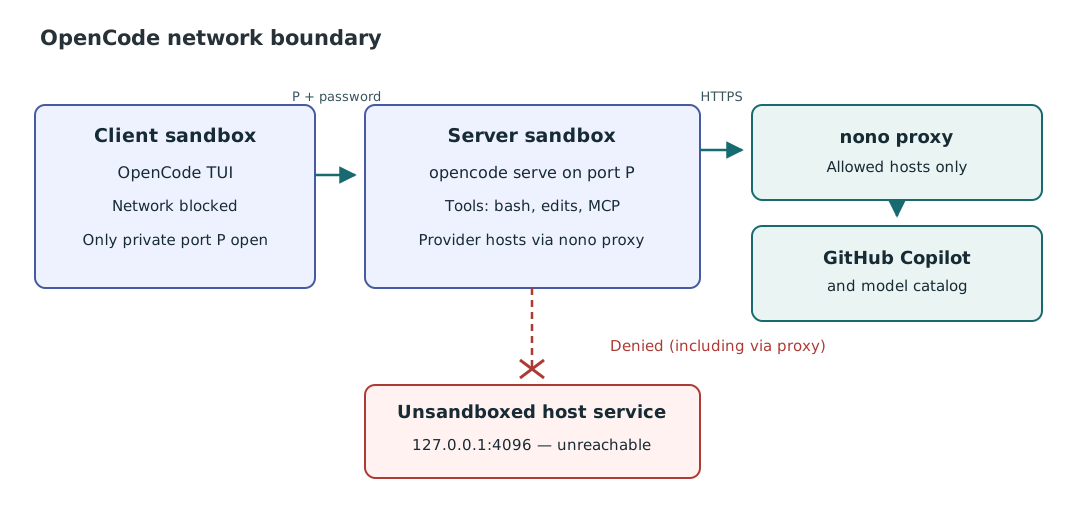
What each sandbox can reach
| Server sandbox (server + tools) | Client sandbox (TUI) | |
|---|---|---|
| Files | The workspace root read-write, plus what the nolabs-ai/opencode pack grants (OpenCode's state and config, toolchains, /tmp) |
Same |
| Internet | HTTP(S) through nono's proxy to the LLM provider's hosts (GitHub Copilot) and OpenCode's model catalog; every other host gets 403 |
None |
| Localhost | Nothing, except accepting its client on P. The host service on 4096 is unreachable, directly and through the proxy |
Only the server on P |
| SSH, databases, UDP | Denied (direct TCP and UDP are blocked) | Denied |
| Herdr's control socket, systemd, D-Bus, SSH and GPG agents, X11/Wayland | Denied | Denied |
HERDR_*, SSH_AUTH_SOCK, DBUS_SESSION_BUS_ADDRESS, TMUX |
Removed | Removed |
Herdr's socket matters most: through it a process can type commands into any other pane, which run outside the sandbox. Profiles lists the settings behind each row.
Why herdr pane run cannot reach the host
herdr pane run <pane> <cmd>, send-text, send-keys and split are
requests to the Herdr server over its control socket,
~/.config/herdr/herdr.sock (or $HERDR_SOCKET_PATH). The server runs the
command in a real pane, outside any sandbox, so a sandboxed process that
reaches the socket can run anything on the host. Three layers stop it:
- No address. nono drops
HERDR_*(environment.deny_vars) and the plugin strips them too, so the sandbox gets noHERDR_SOCKET_PATHand no pane ids. This alone is not enough: the default path is well known. - No connection.
linux.af_unix_mediation: "pathname"makes nono refuseconnect()to any Unix socket the profile does not grant. Neither shipped profile grants Herdr's. The socket file is visible (lsworks), but connecting fails withEPERM, and theherdrCLI fails withPermission deniedbefore it sends anything. - Checked.
doctorconnects to the socket from a sandbox with the server profile (herdrSocket, critical) and fails if it gets through.
Verified with Herdr 0.9.1 and nono 0.78.0 by running inside each shipped profile, with the socket path set by hand, against a pane id that does not exist (an answer would prove access without running anything):
cd "$(mktemp -d)"
nono run --silent --profile "<plugin root>/profiles/herdr-opencode-server.json" --allow "$PWD" -- \
  sh -c 'HERDR_SOCKET_PATH=$HOME/.config/herdr/herdr.sock herdr pane run zz:p999 true'
# Error: Os { code: 1, kind: PermissionDenied, message: "Operation not permitted" }
The same command on the host, or under a copy of the profile without
af_unix_mediation, gets Herdr's answer
{"error":{"code":"pane_not_found",...}}: the server was reached, and a real
pane id would have run the command. So keep the mediation setting in every
profile you write (Keep these settings).
test/integration-sandbox.test.mjs runs this check, and the control without
mediation, whenever nono and a Herdr server are present.
How it is checked
- After every launch the plugin walks both process trees from outside,
through
/proc, for up to twenty seconds. It requires that every process is confined (no_new_privsset,NONO_CAP_FILEpresent), that the server sandbox runsopencode serve ... --port P, that the client points at that port, and that no process holds a connection to the host service. If any check fails, the agent is stopped and markedfailed(onVerificationFailure: "stop"). The result shows in the overlay andinfo. - On demand:
verify-sandbox, orvin the overlay, while a tool runs. - Before every launch the plugin resolves the server profile with
nono profile showand refuses to start (unconfined) when an allowed domain can reach localhost (below), whether or not the host service runs at that moment. doctorstarts a throwaway sandbox with the server profile and tries to reach Herdr's socket, systemd, D-Bus, Docker, the SSH and GPG agents,~/.ssh, your home directory and the host service port. It also listens on a random port of the host's127.0.0.1and tries that port directly and through nono's proxy as127.0.0.1,localhost,0.0.0.0,127.1,[::1]and127.0.0.1.nip.io(loopbackCanary,loopbackViaProxy). A critical success (Herdr, systemd, D-Bus, Docker, localhost) failsdoctorwithunconfined.
The checks run outside the sandbox, so the agent cannot fake them.
Two test files repeat them against the real nono (skipped without it, or with
HERDR_NONO_INTEGRATION=0), each with a control that removes the protection
and shows the test would catch it:
| File | Checks |
|---|---|
test/integration-egress.test.mjs |
No localhost from the server sandbox, directly or through the proxy under any loopback name; the host service port; Copilot hosts allowed, other hosts 403; "*" and localhost refused before launch |
test/integration-sandbox.test.mjs |
No host Unix socket from either sandbox, even in a writable directory; herdr pane run fails in both; no HERDR_*, SSH, GPG, D-Bus or tmux variables; doctor's probe passes for both profiles; workspace writable, home not; the client reaches only its server's port, the server listens only on it |
What it does not protect
The OpenCode host service
The host service's password sits in ~/.local/state/opencode/service.json,
inside a directory OpenCode must be able to write, and nono cannot hide one
file in a granted directory. The agent can read it, but with the shipped
server profile it cannot reach the port, so the password is useless. With a
server profile that opens localhost, the plugin refuses to start agents while
the service runs, or while it could start (hostServiceCheck: "refuse"), and
doctor fails.
Shared OpenCode config and state
Sandboxed and host OpenCode share sessions, auth and config. The pack grants
~/.config/opencode (and ~/.claude, ~/.codex) read-write, so the agent
can add a plugin or MCP server that a later unsandboxed OpenCode loads.
Review changes there before running OpenCode outside the plugin.
The workspace
The agent writes your checkout, including .git/hooks, build scripts and CI
files. Anything you run from it on the host afterwards runs unconfined.
Egress to the allowed hosts
The agent can send anything to the allowed hosts, your workspace included.
github.com and api.github.com serve more than Copilot (gists, issues, any
repository your token can write), so the allowlist limits where data can go
but does not stop exfiltration to GitHub.
Why egress is an allowlist
In proxy mode nono denies direct connects, but its proxy forwards to any
host the allowlist matches, localhost included. With allow_domain: ["*"],
the shipped value up to 0.1.0, a sandboxed process reached the host service on
127.0.0.1:4096, and any other loopback port, by sending
CONNECT 127.0.0.1:4096 to the proxy. OpenCode's host service usually runs
(plain opencode restarts it), so the plugin cannot rely on it being stopped.
The proxy also does not check what an allowed name resolves to. Allowing
localhost, an IP address, a single-label host name, a .local or
.internal name, or a wildcard DNS name such as 127.0.0.1.nip.io or
*.localtest.me opens localhost just like "*". So:
- the shipped server profile allows only GitHub Copilot's hosts and OpenCode's model catalog (Profiles);
- the plugin refuses to launch when the server profile allows any of the
entries above (
hostServiceCheck: "refuse"),doctorfails on them, and the overlay shows+ LOCALHOST; nonoArgsmay not add network flags (--allow-domain,--open-port, ...) and the plugin drops theNONO_*variables nono reads as flags, such asNONO_ALLOW_DOMAIN, before it runs nono.
The remaining assumption: an allowed name never resolves to the host. That holds for the providers' own domains; do not allow a wildcard under a domain whose DNS records other people control.
test/integration-egress.test.mjs checks all of this against the real nono
(skipped when nono or the pack is missing).
Known limitations
- nono rate-limits connections in proxy mode. With AF_UNIX mediation on,
nono 0.78 denies connects beyond roughly ten in a burst. Downloads such as
npm installslow down with retries, and a request can fail with "could not connect to proxy". Spacing requests by 0.1 s avoids it. The alternatives either reopen Herdr's socket or localhost, so this trade-off is deliberate. - Kernel 6.7+ (Landlock ABI v4) is needed for the network rules. On older
kernels run
doctorand checkopencodeServicePort: deniedbefore relying on the localhost lockdown. - No clipboard: X11 and Wayland sockets are blocked.
Trusting the plugin
Installing a Herdr plugin runs its code as your user. This one runs only
its own binary, nono, herdr, git and sh (for the install and key binding
scripts), always as argument lists, never as shell strings built from repository
content. It never reads a secret (it reads the
host service's URL and pid, not its password) and grants nothing beyond the
workspace on top of the profile. Review
herdr-plugin.toml, scripts/ and rust/src/ before installing.
The install step downloads bin/herdr-nono from the project's GitHub release
and checks its sha256 against the SHA256SUMS of the same release. That guards
against a damaged or truncated download, not against a compromised release. If
you need more, build from source (HERDR_NONO_NO_BUILD unset and no release for
your checkout, or cargo build --release --locked) after reading the code.
Tested on Linux 7.0 with nono 0.78.0, OpenCode 2.0.22, Herdr 0.9.1 and the
nolabs-ai/opencode pack 0.2.0. Results depend on the nono version and the
pack; doctor re-checks on your host.